When Should You Use a Joker in Rummy? Mistakes Most Players Make
Getting a joker feels great. Many players immediately start imagining the perfect hand they can build with it. Unfortunately, that excitement is exactly why jokers are often wasted.
A joker is the most flexible card in rummy, but flexibility only has value when used at the right moment. The difference between an average player and a strong player is rarely how many jokers they receive. It is how efficiently they use them.
What is the real purpose of a joker?
Beginners often think a joker exists to complete combinations as quickly as possible.
Experienced players think differently.
The main purpose of a joker is to solve difficult problems in your hand. If a combination can reasonably be completed without a joker, the joker may be more valuable somewhere else.
Do not use a joker too early
One of the most common mistakes happens during the first few turns.
Suppose you have:
- 7♠ 8♠
- Joker
Many players immediately treat the joker as 9♠.
The problem is simple. There are still many cards left in the deck. The actual 9♠ might appear naturally.
Once a joker is committed mentally to a combination, players stop evaluating better opportunities.
Use jokers where the odds are worst
Imagine two incomplete combinations:
- 4♦ 5♦
- Q♠ Q♥
The sequence only needs one specific card, either 3♦ or 6♦ depending on the format.
The set can be completed by either Q♣ or Q♦.
Since the set has more possible outcomes, many experienced players prefer saving the joker for the sequence if progress stalls.
The fewer natural cards that can complete a combination, the more valuable the joker becomes there.
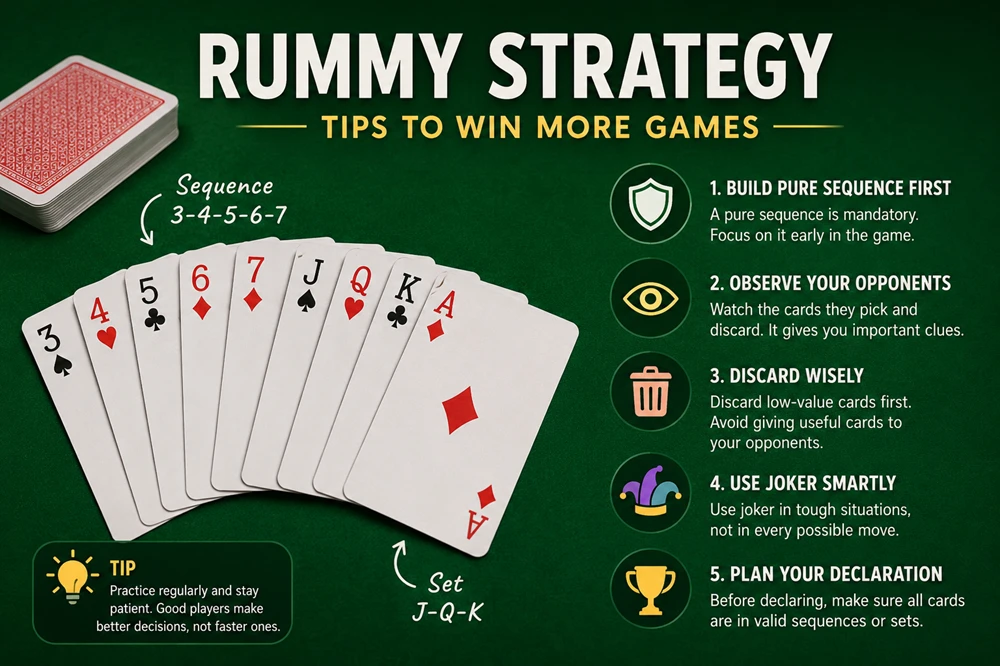
Never use a joker in a pure sequence
This sounds obvious, but new players regularly misunderstand the rule.
A pure sequence must be formed entirely with natural cards. A joker automatically turns it into an impure sequence.
Before using a joker anywhere, make sure your pure sequence requirement is already protected.
Jokers become stronger as the game progresses
Early in the game, many cards remain unknown.
Late in the game, information starts appearing everywhere. You know what opponents have discarded. You know which cards are unlikely to arrive. You know which combinations are stuck.
At that point, a joker becomes far more valuable because the decision is based on information instead of hope.
Use jokers to reduce risk
Sometimes the best joker play is not the most aggressive one.
Consider a situation where another player looks close to declaring. Your priority changes immediately.
Instead of chasing an ideal hand, use the joker to secure existing combinations and lower your potential penalty.
Saving 20 points can be more important than chasing a perfect finish.
When should you hold a joker?
There are situations where the strongest move is doing nothing.
If your hand is still developing and multiple combinations remain possible, keep the joker unassigned.
Think of it as cash in your pocket. The moment you spend it, your options become narrower.
Signs that your joker is being wasted
- You used it within the first few turns without a clear reason.
- You used it in a combination that was likely to complete naturally.
- You ignored a weaker section of your hand.
- You created an impure sequence before securing a pure sequence.
- You committed to one plan too early.
Final thoughts
Strong rummy players do not see a joker as a shortcut. They see it as insurance.
The best joker decisions usually happen after observing the table, understanding the risks, and identifying the hardest problem in the hand.
If you consistently save your joker for the moment it matters most, you will win more games than players who spend it the moment they receive it.